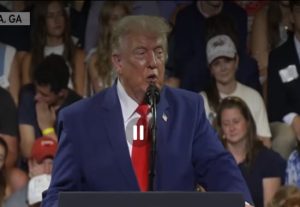
We are making a great deal. If necessary, we will go back and finish it militarily. We are very close to reaching a strong agreement, but if it does not happen, action remains on the table. One guarantee I must have is that there will be no nuclear weapons, and they have agreed to that condition. Progress may have been slow, but Iran is in a very difficult position.
US-Iran peace deal ‘IN LIMBO’ as Trump reportedly sends tougher terms to regime
Hello everyone, and welcome to the second hour of The Big Weekend Show. While President Trump remains in Washington tonight, we continue to await an announcement regarding a potential peace deal with Iran. The commander-in-chief has made his position clear: Iran cannot possess nuclear weapons, cannot maintain a uranium stockpile, and must reopen the strait.
According to The New York Times, representatives presented a new proposal to Iran, increasing pressure on the regime to accept the existing framework. Max Gordon joins us live from Tel Aviv with the latest developments.
A peace agreement between the United States and Iran still remains uncertain after President Trump met with top advisers in the Situation Room on Friday. The meeting reportedly lasted around two hours, but no agreement was announced afterward.
The New York Times reports that a proposal was delivered to help speed up negotiations and place additional pressure on Iran to move faster. However, it remains unclear what changes, if any, were made to the proposed agreement.
Meanwhile, the Strait of Hormuz remains closed to ship traffic as the United States continues its blockade.
“First and foremost, the strait must reopen immediately. Beyond that, there can be no nuclear weapon. That is the bottom line. It is very simple. We are going to leave, and we do not need the strait.”
Meanwhile, Israel continues its military campaign against Hezbollah militants in southern Lebanon. The military announced it had advanced farther into Lebanon than at any time in the last 26 years, crossing the river and capturing a historic castle positioned on strategic high ground.
Israeli troops had previously captured the same castle in 1982 and held it until withdrawing in 2000. Since the current cease-fire with Lebanon began, Israel says it has killed approximately 900 Hezbollah fighters.
The latest military advance into southern Lebanon comes just days before another round of talks between Israel and Lebanon at the State Department. Regional leaders have stressed that any peace agreement must include an end to the fighting, though the latest military operation may complicate negotiations.
With continued focus on the Middle East, President Trump has expanded the role of the U.S. ambassador to Turkey, appointing him as special envoy to both Iraq and Syria.
Tomi: Max Gordon, thank you very much. Eric, Joey, we are still waiting for a peace deal. No one knows exactly how soon one may come. President Trump said time is on his side and on our side, and we continue to wait closely for developments.
My question for both of you is this: President Trump said last night that returning to military action remains an option. What would that actually look like after an extended cease-fire and ongoing negotiations? How would the American people respond? How would Iran interpret such a move? And how do you see this situation unfolding?
US-Iran peace deal ‘IN LIMBO’ as Trump reportedly sends tougher terms to regime
On the technical side of things, the question becomes whether Iran has been rebuilding and resupplying itself. Are they restoring systems, preparing long-range missiles, and continuing drone production? Most likely, they are. China has invested heavily in those capabilities, and it is difficult to believe production has completely stopped or that every operational site has been identified.
On our side, the United States has already used a significant amount of Patriot systems. Those resources are now being replaced, while officials seek additional funding. The biggest challenge is not necessarily affordability, but availability. Time becomes a major factor. Every time expensive weapons are used to destroy relatively inexpensive targets, those resources become harder to replace.
At the same time, valuable lessons have been learned. The United States has gained insight into its brown-water naval capabilities and discovered areas where improvement may still be needed. There has also been a better understanding of radar systems provided by China and reportedly used by Iran.
At the end of the day, for this agreement to truly work, two things have to happen. First, there must be real progress regarding Iran’s nuclear program. If Operation Midnight Hammer genuinely damaged or destroyed nuclear capabilities, then there has to be visible evidence presented to the American people.
Second, this cannot simply be viewed as a peace agreement centered on reopening the strait. The strait had already been operating before all of this escalated. There needs to be a more meaningful outcome that clearly explains why these actions were necessary.
Some of the answers may involve classified intelligence that the public will never fully see. Still, the American people want to understand why all of this matters, particularly at a time when concerns about another prolonged conflict remain high.
The larger question is how much patience Americans are willing to have. Economically, many households may be capable of enduring a longer geopolitical conflict, but frustration is clearly growing as gas prices rise and everyday living costs continue to increase.
At the same time, consumers have not completely pulled back from spending. Consumer activity remains strong, and that continues to support a major portion of the economy. So while patience may be thinning, there is still some room for flexibility. Ultimately, however, this becomes a political issue.
Was President Trump right to pause military action and move into extended negotiations? That remains a difficult question. Some believe the military operation significantly weakened Iran’s capabilities and that a few additional weeks may have completed important strategic objectives. Others argue the cease-fire created an opportunity to strengthen the blockade and reinforce military readiness in the region.
In the end, if military action resumes, the outcome will need to be clear and measurable. Americans may be willing to tolerate higher gas prices if they believe there is a clear victory. What many may not support, however, is uncertainty without a visible result.